The Psychology Behind Calm, Connection, and Confidence
When people think about having an organized home, they often picture perfectly labeled bins, spotless countertops, or magazine-worthy pantries. But for families raising neurodivergent children or children with behavioral challenges, organization isn’t about perfection. It’s about creating a home that supports emotional regulation, reduces stress, and helps every family member thrive.
Through my work supporting a families, and my own journey parenting children who have needed extra support, I’ve seen firsthand how thoughtfully organized environments can make everyday life feel calmer and more manageable.
For many families, the goal isn’t a picture-perfect home. It’s a home that works.
The Psychology of an Organized Home
Our brains are constantly processing information. Every toy on the floor, pile of paperwork, or overflowing countertop competes for our attention. Psychologists refer to this as cognitive load, the amount of mental effort our brains use to process information.
When our environment is cluttered, our brains work harder simply to filter out distractions. This can leave us feeling overwhelmed, mentally exhausted, and less patient.
For neurodivergent children, including those with ADHD, autism, sensory processing differences, or anxiety, this mental overload can be even more intense. Many children are already working hard to process sensory information, manage emotions, and navigate social expectations. A chaotic environment can add another layer of stress.
An organized home helps reduce that burden by creating predictability and minimizing unnecessary stimulation.
Organization Creates Emotional Safety
One of the greatest gifts we can give children is predictability.
Children who struggle with executive functioning or emotional regulation often feel safer when they know what to expect. Simple routines and organized spaces create consistency, allowing children to spend less energy figuring out what comes next.
Something as simple as:
- Backpacks always hanging on the same hook
- Shoes always stored in the same basket
- Homework completed at the same table each afternoon
- Favorite comfort items kept in familiar places
may seem small, but these routines communicate stability.
When children know where things belong and what their daily rhythm looks like, they often feel more confident and independent.
Supporting Executive Function Through the Environment
Executive functioning is responsible for skills like planning, organizing, remembering instructions, starting tasks, and managing time.
These skills don’t come easily for many neurodivergent children.
Instead of expecting children to “just get organized,” we can design our homes to support them.
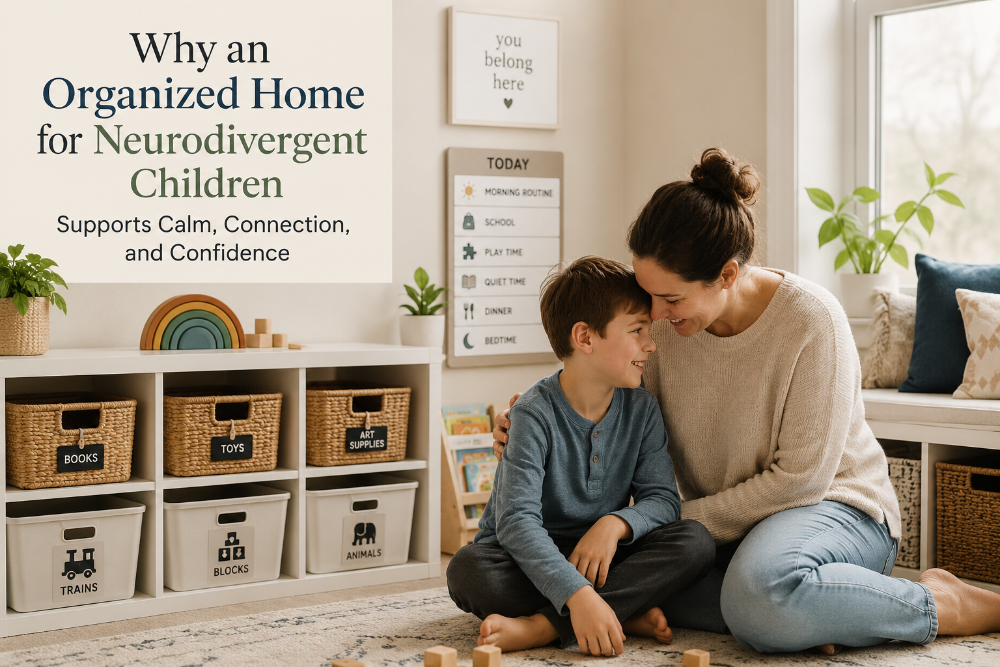
Clear bins, labels, open shelves, visual schedules, simple storage systems, and designated spaces for everyday items help reduce frustration.
In many ways, the environment becomes an extension of the child’s executive functioning.
Rather than constantly reminding a child where something belongs, the home itself provides the answer.
That’s not spoiling a child. It’s giving them tools for success.
Reducing Stress for the Entire Family
Parents often underestimate how much mental energy they spend searching for missing shoes, permission slips, chargers, backpacks, or library books.
Every missing item creates another decision to make.
Psychologists call this decision fatigue. The more decisions we make throughout the day, the harder it becomes to regulate our emotions, solve problems, and remain patient.
Having organized systems reduces those unnecessary decisions.
When everyone knows where things belong, mornings become less chaotic, bedtime routines become smoother, and families spend less time managing “stuff” and more time enjoying one another.
Progress Over Perfection
One lesson I’ve learned from working with children is that perfection isn’t the goal.
Progress is.
The same applies to organizing your home.
Some days the laundry won’t get folded. Toys will end up in unexpected places. Life happens.
Creating an organized home isn’t about maintaining unrealistic standards.
It’s about intentionally designing spaces that support your family’s unique needs.
For one family, that might mean using picture labels on toy bins.
For another, it could mean having a calming sensory corner where a child can decompress after school.
Every family looks different, and that’s okay.
Organization Builds Confidence
Children notice when they’re successful.
If a child can independently find their backpack, put away their shoes, or pack their lunch because the system makes sense, they’re building confidence every single day.
Too often, children with behavioral challenges or executive functioning differences hear messages about what they’re doing wrong.
They forgot.
They lost something.
They made another mess.
An organized home helps create opportunities for success instead.
Those small successes matter.
Confidence grows through repeated experiences of capability.
Creating a Home That Works for Your Family
Every family deserves a home that feels supportive rather than overwhelming.
That doesn’t mean buying expensive storage systems or spending every weekend organizing closets.
It means creating simple routines, reducing visual clutter where possible, and remembering that organization is a tool, not a measure of your worth as a parent.
The most important thing isn’t how your home looks to visitors.
It’s how your family feels inside it.
When children feel safe, supported, and understood, they’re better able to learn, grow, and develop independence.
For neurodivergent children especially, thoughtful organization isn’t about creating perfect spaces. It’s about removing unnecessary obstacles so they can focus on what matters most, being children.
At the end of the day, an organized home is really about something much deeper than tidy shelves or color-coded bins. It’s about creating an environment that nurtures emotional well-being, supports executive functioning, reduces stress, and strengthens family connection.
Because every child deserves a home that helps them succeed, not by asking them to fit the environment, but by shaping the environment to meet them where they are.



Leave a Reply